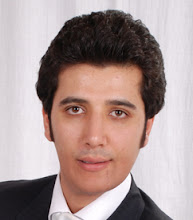
Things haven’t been easy for Arash Sigarchi. At the age of 27, he was sent to prison for writing articles criticizing the leader of the Islamic Republic and aspects of life in Iran. He was first sentenced to 14 years, charged with "insulting Mr. Khamenei in his writings, collaboration with hostile governments, giving interviews to foreign media, and incitement of the public mind." His sentence was subsequently commuted to 3 years, of which he has served 14 months. During his time in prison, he found a lump in his mouth. It was cancer. He underwent an operation to excise the tumor as a result of which he lost part of his tongue.
Sigarchi began his career in journalism when he was just 15 years old. A native of the Gilan province of northern Iran, he gained acclaim for his work as editor of Gilan Emrooz, the province’s major newspaper. When he was no longer able to publish the kind of stories he wanted to in the paper, he decided to start a blog called Panjereh Eltehab, which means “window of anxiety.” For his courage and dedication in the field of journalism in Iran, Arash Sigarchi received the Hellman/Hammett award in 2007.
(from IJNet interview)
The armed forces Joint Chief of Staff criticized the “faction in Majlis and administration colluding with America” and accused those who support relations with America of being enemy “infiltrators.”
Major General Seyyed Hasan Firouzabadi, who was speaking to the Joint Staff Chief generals, reacted to recent remarks by Ali Larijani indicating “reviewing possible responses to members of American Congress” by saying, “The danger that threatens the revolution today and at this juncture in time is that the Americans send messages and some people say here that we are reviewing messages from Americans.”
This military official, who received a “medal of independence” from Mahmoud Ahmadinejad two weeks earlier, added, “People who say these things are American infiltrators. The reformists said the same things too.”
What Major General Firouzabadi is criticizing in his interview are seeming attempts in recent weeks by several government officials to establish relations with the United States.
Eighth Majlis Speaker Ali Larijani, though he has likened the president-elect of the United States in recent days to a “cowboy,” in several occasions he has discussed the letter authored by several American senators seeking to negotiate with members of the Iranian Majlis. Larijani said last week to IRNA that he is reviewing the letter of American senators to Iranian lawmakers, adding, “We have not yet responded because it is necessary for us to know around what issues these negotiations would revolve.”
Major General Firouzabadi is a military figure close to the Islamic Republic Supreme Leader Ayatollah Ali Khamenei and among the handful of military icons who have preserved their position since Khamenei’s appointment to supreme leadership. Firouzabadi has served as the Islamic Republic’s Joint Staff Chief since 1368 (1990). The institution is the highest armed forces institution in Iran which is in charge of strategizing and managing all of Iran’s armed forces, including the army, the Revolutionary Guards and the State Security Forces.
Influential criticisms by Hashemi Rafsanjani, Mohsen Rezaei, Danesh-Jafari and Pour-Mohammadi of the Ahmadinejad administration’s economic policies during the seminar, “Privatization: Obstacles and Opportunities,” which was held by the Student Basij organization, has enraged the administration’s supporters.
Hashemi Rafsanjani said during the seminar, “The Supreme Leader requested from the Expediency Council in a clear letter to devise policies and strategies in connection with implementation of Article 44 of the Constitution [privatization]. In 2004, when we finished our work, the Supreme Leader approved very quickly… We said give us five years and the government will transfer 20 percent of factories and facilities under its ownership to the private sector every year, the Supreme Leader approved and signed… Another policy the Supreme Leader was more concerned about than us was the issue of dependency on oil. At that time he said that my dream is to celebrate the closure of the last oil well, so we devised a 10-year plan according to which every year the government reduces its dependence on oil by 10 percent.”
Hashemi Rafsanjani then added, “Five years have passed since that date. The big question that lingers is, how much has this been implemented? Our oil revenues that have been unprecedented in history, how have they been spent? Have we spent them on development? These questions are not related at all to political competitions. Here, we are talking about implementation of Supreme Leader’s policies and these questions must be answered clearly.”
In another part of his speech, noting the ninth administration’s slow pace of privatization and unaccounted for expenditure, Hashemi Rafsanjani asked of the Basijis, “You must ask what has happened to revenue generated from privatizing factories and government facilities? We hope that everything was conducted in accordance with law.”
Rafsanjani also asked the Basijis to pay more attention to issues related to Article 44: “The source of these policies is your Supreme Leader and you must feel the duty to implement them more than ever. Allah willing, you will not be accused of politicking and creating obstacles. Your stances are clear and you will not be accused of opposing the Supreme Leader’s orders.
During the seminar, when one member of the Student Basij accused the gathering o being political and asked Hashemi why no representative from the ninth administration was invited to the gathering to respond to the charges, Hashemi cleverly responded, “Really you should ask this of the administration, I cannot respond to this on their behalf. Head of all three branches must be held responsible when it comes to Article 44.”
Reacting to Hashemi Rafsanjani’s speech at the Student Basij seminar, Raja News website, affiliated with the administration, wrote, “The aforementioned seminar contains discussions and remarks that are devised and voiced only to oppose the Ahmadinejad administration, so much so that the suspicion was that this gathering was organized by reformist groups, but the reality is otherwise.”
Noting that “the gathering lacked responsible and measured leadership by the Basij,” Raja News concluded, “holding such gatherings with guest whose only motivation seems to be to blast and question the administration and its policies achieves nothing other than to destabilize the environment and question the performance and service of the present administration.”
President George W. Bush meets with international bloggers and new media users on human rights Wednesday, Dec. 10, 2008, in the Roosevelt Room at the White House. White House photo by Chris Greenberg
Today is December 10, and President of United state invited me and some Journalists and blogger from several country. Following text is my speech in With House:
It`s a pleasure to be here as an Iranian journalist and blogger.
As an Iranian person I want to tell you Mr. president, Thank you for always separating Iranian people from Iran`s government.
History is a good science because it tells us that 60 years ago Eleanor Roosevelt, First Lady of the United States, helped to create the Universal Declaration of Human Rights. Also, history tells us Five Hundred years before Christ, there was a king in Persian that helped to develop Human rights. Cyrus the Great was a supporter of peace for other countries and he freed the Jews and repatriated them to their region following their Babylonian captivity.
Yes, history also tells us, Now there is a president in the Islamic republic of Iran that said "Israel must be wiped off the map." You can compare these two act together.
Mr. President,
I know you understand that Iranian people have problems with their government. Now I want to tell you about my experience on how I could promote reform despite the government and try to stop it.
I`ve been working as a journalist for over ten years. I started my blog seven years ago, when the Iranian ministry of intelligence pressured me to censor some news.
I wrote articles about Iran’s nuclear energy activity and asking it to stop but they forced me not to publish these articles. Censorship is the worst thing to journalists so I decided to challenge it.
Some other journalists and I use a new technology for the war against censorship. The Style of work was easy. Everything that was impossible to publish in newspapers, we published on weblogs.
After a short time, my blog became famous for reporting real, uncensored news.
Unfortunately, Iran`s government became sure that the Internet and blogging helps spread democracy and for this reason, they started the filtering and persecution of blogs.
They didn’t tell people that everything was being filtering. They told them we filter only immoral sites.
There is a lot of Persecution. They arrested me in 2005 and first sentenced me to 14 years of prison and then in the appeal court reduced it to 3 years. Also, around the same time, the Iranian government arrested more than 45 bloggers and journalists and held them in solitary confinement for a long time.
Now, More than five Millions sites and blogs are filtered in Iran.
In the meantime, Sepah Pasdaran (Islamic Revolutionary Guards Corps) decided to start ten thousand new blogs. A special Magazine of IRGC announced that the US government wants regime change in Iran by using public policy tools like the Internet and blogs.
I want to tell you why blogging is important and why it help to the spread of democracy in Iran.
Iran is the fifth Classification in the world and we have half a million bloggers. They write, take pictures and publish their blogs daily or weekly.
Iran doesn’t like this because my colleagues publish important data. We write about "abuses of human rights in Iran", "Iran`s nuclear activity", "women rights" and other things. I want to tell you a fresh example:
President Ahmadinejad elected Mr. Ali Kordan as "interior ministry of Iran" four months ago. They told us, Ali kordan is "Honorary doctorate in law from Oxford University". Iranian bloggers very soon discovered Ali Kordan doesn’t have this honorary degree. More than twenty thousand blogs wrote that the new minister lied. This wasn’t the end of his case. After a short time, we realized he doesn’t have any degree, either a Masters or a bachelor degree. He only had a simple diploma. Finally, the Iranian Parliament impeached him after ninety days only. That was Success for Iranian blogger community.
Blogging rose in Iran. Now, Iranian student use this technology to publish their activities. Also, most of all women use it. They are involved in the campaign for "one million signatures Demanding Changes to Discriminatory Laws" and they write about their successes and experiences on blogs.
Before ending my talk, I want to give you some messages from Iranian bloggers. I asked them what they would like to ask the President of the United States. I asked about 45 people Inside Iran. More than 30 persons had the same request. They believe that Iran is buying filtering technology from American and Chinese company. They ask you, please don’t allow American companies to sell such technology to the Iranian government for extending ofg censorship and Filtering..
Another point raised was about supporting democracy in Iran. Iran has a Young population. 70 percent are under the age of 35. Also, 60 percent of Iranian bloggers are under this age. For this reason, they need a new media.
And Finally, They wish to tell you, although Iran’s government supports some terrorist groups, but the Iranian people are not the Axis of evil.