Showing posts with label Human right. Show all posts

Sunday, August 31, 2008

National Peace Council Begins Its Work

To Prevent War

‎solh771.jpg

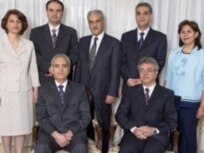
Just two months after 72 Iranian pro-peace personalities signed a peace drive, the ‎founders of the National Peace Council held their second meeting. At the meeting, the ‎activists ratified the charter; the general assembly voted its executive operatives and ‎inspectors, thus officially launching the group.‎

Fifteen individuals were elected from the members of the general assembly to act as the ‎executive board which is mandated to run the group’s affairs, except those identified by ‎the general assembly. Hashem Aghajari, Babak Ahmadi, Habibollah Peyman, Jalal ‎Jalalizadeh, Taghi Rahmani, Issa Saharkhiz, Abdoll-FatahSoltani, Hossein Shah-‎Hosseini, Seyed-Ali Salehi, Keyvan Samimi, Abdollah Momeni, Hossein Mojahed, ‎Narges Mohammadi, Baizid Mardookhi, and Fatemeh Motamed-Aria were elected as the ‎members of the executive board, while five others, Hossein Akbari, Mohammad Sadegh-‎Rabani, Kurosh Zaeem, Soraya Aziz-Panah, and Parvin Kahzadi were elected as ‎substitute members.‎

In addition, Ezatollah Sahabi, Abbas Abdi and Dawood Hermidas-Bavand were elected ‎as the principal inspectors of the organization, while Mohammad Khaksari, and Jhila ‎Shariatpanahi were elected as substitute inspectors.‎

Issa Saharkhiz, a regular contributor to Rooz, and now a member of the executive board ‎of the Peace Council said that members to the group was open to anyone, regardless of ‎their political leanings, adding, “Anyone who is concerned about peace and is interested ‎in preventing the country from getting into one, can become a member.”‎

Last February as tensions between the US and Iran reached levels that had produced fears ‎that military action against Iran was a real possibility, Shirin Ebadi, Iran’s only Nobel ‎laureate announced the creation of a temporary peace committee and called on all Iranian ‎to participate in efforts to prevent such a war.‎

The Peace Council has set four goals for itself: the creation and strengthening of the ‎foundations for peace, human rights and continues development in Iran; preventing any ‎military, terrorist and violent action against Iran; activities to remove any sanctions ‎against Iran and prevent their strengthening, and; ending the atmosphere of ‘no war and ‎no peace’ that is in air.‎

The individuals forming this group include critics of the government, professional ‎journalists, commentators, women activists, former government officials, human rights ‎activists, lawyers, university academicians, and political activists.‎

Saturday, May 31, 2008

Bahais Continue to be Arrested

Following Calls for ‘Revolutionary Execution’ of Detainees

As some religious leaders in Iran have called for “the utmost punishment” for detained ‎Bahais using state media resources, the confrontation with the followers of this belief has ‎intensified and yesterday such calls went deep into the country. Bahai leaders in ‎Vilashahr in the province of Isfahan were reported to have been arrested. ‎

The news website “Human Rights Activists in Iran” announced that according to its latest ‎reports, the leaders of the Vilashahr Bahai community in Isfahan were arrested. Their ‎names were listed as Hushmand Talebi and Mehran Zini, and Farhad Fardossian who is ‎said to be a member of the community. The news site reports that these individuals were ‎arrested by security-law-enforcement agents and transferred to the prison of the town, ‎while their conditions remains unknown.‎

In a related news story, it is reported that three other Bahais named Ali Ahmadi, Changiz ‎Derakhshan, and Ms Simin too have been arrested in the northern town of Ghaemshahr. ‎Prior to that, six leading members of the Iranian Bahai community were arrested, and ‎their names are Fariba Kamal Abadi, Jamaledin Khanjani, Afif Naimi, Saeed Rezai, ‎Behrouz Tavakoli and Vahid Tizfahm. Mahvash Sabet, another Bahai leader was arrested ‎earlier in March in the city of Mashhad. All of these seven last members comprised the ‎leadership of the sect in Iran.‎

These new arrests follow the claims by Iranian authorities that the Bahais had been ‎arrested because of their anti state activities that threatened national security. Elham the ‎spokesperson for the Iranian government had said in his weekly meetings with the media ‎that “these individuals had been arrested because they had engaged in activities against ‎the security of the state and had been in contact with foreigners particularly Zionists.”‎

Seyed Ahmadi El Alhodi, the Friday prayer leader of the city of Mashhad had recently ‎publicly called for the “revolutionary execution of the Bahai-Israeli spies”. According to ‎Shabestan news agency, this cleric said that Bahaism was not a religion and claimed that ‎‎“Bahaism was neither a religion nor even an idea” adding how could he accept these ‎‎“Israeli soldiers whose hands were stained with the blood of millions of people be ‎allowed to freely move around the Iran and, by taking advantage of a group of political ‎deviants and loose women and sex-driven boys, engage in collecting signatures to destroy ‎Islamic laws by engaging in any criminal activity.”‎

Elm Al Hodi further said that the harshest revolutionary punishment should be imposed ‎on the members of this Satanic group, calling on the judiciary of Iran to forcefully ‎confront this espionage movement without any heed to the wishes of the US and … , as ‎the group engaged in espionage behind the backs of the intelligence community of the ‎country

Sunday, May 25, 2008

People Must React Too!

Increasing Crackdown on Bahai Community
A week into the arrest of six Bahai leaders in Iran, an interview published by hardliner ‎Fars news agency called for the “creation of a popular movement” to “confront and fight ‎Bahaism” so that the “government is not left alone in its confrontation against the Bahai ‎community.” ‎ The interview was held with Seyed Kazem Mousavi who is introduced as an analyst and ‎expert in contemporary Iranian history, in which he is quoted as saying “Bahais in Iran ‎are attempting to gain independence and legitimacy by being present in cultural and ‎economic fields and to infiltrate the power structure and other political spheres." ‎ Denouncing the “Bahai community's attempt to infiltrate the power structure in order to ‎gain access to regime’s secrets, reduce regime’s sensitivity to Bahai cult and downplay ‎dangers associated with this cult,” Mousavi added, “Currently, the Bahai community is ‎trying to hide its true face and pretend to be an ordinary and normal part of society. The ‎Bahai community is planning to attract the support of international organizations such as ‎Amnesty International to fulfill its mission.” ‎ Noting that Bahai followers “claim not to get involved in politics,” Mousavi claimed, ‎‎“This very non-interference in politics is itself a political move, designed to gain ‎immunity to freely and seriously participate in cultural and economic activities. Prior to ‎last winter’s Majlis elections, the leaders of the Bahai movement ordered their followers ‎to participate in elections. Some Bahai groups protested that decision, to which the Beit ‎al-Adl of Bahais responded by clarifying that it was not forbidden to participate in ‎elections and vote for independent candidates, just to support political parties.” ‎ This Fars news analyst finally declared, “The Bahai community is manipulated by the ‎Zionist regime and enjoys the support of Israel.” ‎ Fars news agency published this interview while several conservative websites attempted ‎to blame Bahai followers for last month’s explosion in a Shiraz mosque. According to ‎the reasoning of these websites, because the mosque where the explosion took place was ‎a meeting ground for some “anti-Bahai” activists, the Bahai followers were “seeking ‎revenge.” ‎ At that time, human rights activists warned against the consequences of these baseless ‎charges and predicted an intensified crackdown on the Bahai community in Iran. ‎
-------------------------
PS. a friend send for me this photo :

Sunday, April 13, 2008

Ghabel Ends Up in Prison Too

A Judgment Calculated to be Implemented after Elections

Without any prior warning, Hadi Ghabel, a cleric member of the Central Council of Jebhe ‎Mosharekat reformist front (Participation Front) was arrested on Monday and sent to ‎Langarood prison in Qom.‎

This news was broken by Ghabel’s son, Ruhollah who said, “My father had been ‎summoned by Qom’s special Clerics Court on March 26th, 2008. He requested an ‎extension and went to the court yesterday (on Monday). Because the court had not ‎announced that it was going to implement the sentence against my father, he was not ‎ready for detention, but was nevertheless transferred to a prison in Qom.”‎

Jebhe Mosharekat front, on whose central council Ghabel had served in the past, issued a ‎statement regarding Ghabel’s arrest in which it protests against the ‘unfair” execution of ‎a sentence and reminds the public that the execution of the sentence had been suspended ‎by the judiciary officials based on the negotiations that had taken place.”‎

The statement also reads, “A review of the charges against Ghabel indicate that a case ‎was concocted against him based on the public speeches that he had made which included ‎his political, religious and Shiite views, as well as his criticisms since 1997. From ‎amongst his writings and speeches, selected sentences and paragraphs had been extracted ‎to serve as documents for the arrest.”‎

Last Wednesday, agents approached Ghabel’s house on the pretext of having religious ‎questions. When the cleric appeared at the front of his house, they pushed their way ‎inside and after searching the rooms confiscated his papers, writings and computer, and ‎took him to prison. The following Tuesday, Jebhe Mosharekat issued a statement in ‎which it condemned his detention, while his imprisonment lasted for 2 months.‎

Despite the express legal provisions that political crimes must be reviewed in the ‎presence of a jury and must be public, Hadi Ghabel was interrogated repeatedly taken to ‎the Clerics Court during his two month detention and was finally sentenced to 40 months ‎of imprisonment. He was also defrocked.‎

The details of the sentence issued by the Qom court also assert that he had committed ‎acts against national security for which he was sentenced to 1 year of imprisonment, 10 ‎months for engaging in propaganda against the state, 15 months for spreading lies and ‎rumors with the purpose of disrupting public peace, the payment of 500,000 Tomans ‎‎(each US Dollar is about 850 Toman in the market) for insulting state and religious ‎officials, and imprisonment of 100 days for insulting judiciary leadership, the general and ‎revolutionary prosecutor of Tehran, and other judiciary officials. ‎

His defense attorneys have protested against the sentence passed against Ghabel and filed ‎an appeal. The second district of the court of appeals for the Clerics court however, ‎upheld the judgment.‎
-------------------------------
recommendatory note : I taken many photos of Washington DC , yeasterday. You can see here

Saturday, April 5, 2008

Boutimar Sentenced to Death for Second Time

\A New Sentence from the Revolutionary Court
The Revolutionary Court of the city of Marivan, in western Iran, sentenced Kurdish activist Hiva ‎‎(Abdolvahed) Boutimar to death for the second time. Although the written judgment has not yet ‎been served on Boutimar due to the Iranian New Year holidays that began on March 20th and ‎usually continue for about 2 weeks, a judge verbally notified Boutimar's attorney of the ‎judgment. ‎

Hiva (Abdolvahed) Boutimar used to publish a journal belonging to the "Sabz Chia" (literally ‎translated as Green Mountain) association, which is an active environmentalist organization in ‎Marivan. He was one of the association's founders and served on its board of directors.

Last summer, following his arrest by the Intelligence Ministry, the Revolutionary Court of the ‎city of Marivan sentenced Hiva Boutimar and a colleague, Adnan Hassanpour, to death on ‎charges of acting against national security and espionage. Hassanpour was a manging editor at ‎the Kurdish-Farsi journal "Asou." ‎


The death sentences of these two Kurdish activists sparked international protests. Following an ‎appeal filed by the attorneys of the two defendants, the appellate court rejected Adnan ‎Hassanpour's request and upheld the original sentence, but returned Hiva Boutimar's case to the ‎Revolutionary Court for a review. Hiva Boutimar appeared at the Revolutionary Court on 27 of ‎Bahman (March 17, 2008), and the court has once again issued the death sentence for Boutimar. ‎
While in prison, Hiva Boutimar and Adnan Hassanpour staged a hunger strike to protest their ‎inhumane treatment and for being kept in solitary confinement for more than 50 days. Currently, ‎Hiva Boutimar is kept at a detention facility in Marivan while Adnan Hassanpour is held at ‎Sanadaj's general prison ‎


Some sources had previously reported that the court sentenced these two activists to death based ‎on confessions extracted from them through torture and while under duress. These reports ‎indicate that prison and intelligence officers had subjected the two Kurdish activists to severe ‎mental and physical tortures to force them to make false confessions about their alleged charges ‎on tape and participate in a television program. Adnan Hassanpour's mother was also put under ‎pressure to convince her son to appear in front of the camera and confess to what was asked of ‎him. ‎


Officers from the Ministry of Intelligence have removed Hiva Boutimar several times from a ‎prison to an Intelligence Ministry facility in Sanandaj to force him to appear in front of cameras ‎and confess to charges against that incriminate him. These agents had promised Hassanpour that ‎they would arrange for his release if he agreed to confess to charges of espionage in a televised ‎program.